Chris Balcombe

Chris lives in the UK and has a number of original props from the classic Doctor Who period, and a few from the Chris Eccleston/David Tennant series. A small selection of the collection can be seen here.


Chris is still collecting big-time! So if YOU have something original, please email him. He pays quickly and with cash!

All images are watermarked and copyright. Member of the National Union of Journalists


If you happen to watch the BBC 20th Century Roadshow you will likely have seen Chris collection featured on that show. If you missed it have a look now.
20th Century Roadshow
Windows Media Player
Real Media Player
Real Media Player (Low Bandwidth version)


If you have any original, screen-used Doctor Who props from the current or original series, and are interested in selling, please feel free to drop Chris an email.


Chris can be contacted by Email Chris


.
Enjoy this small sample of Chris's Collection
.

Click on the section below to see more
Merchandise

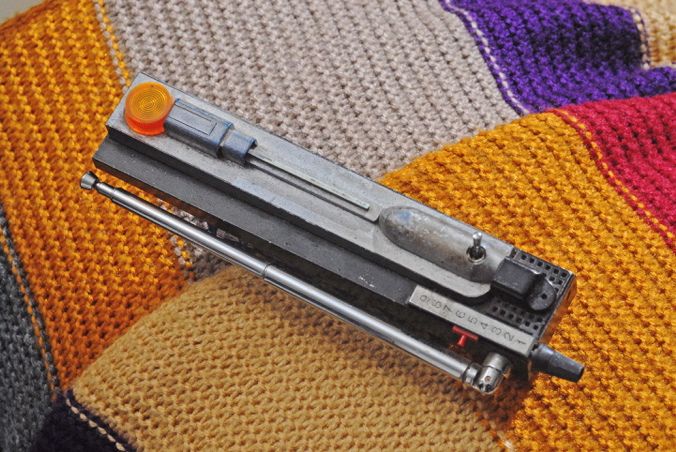
Pyramids Of Mars. Doctors Stellar Signal Receiver
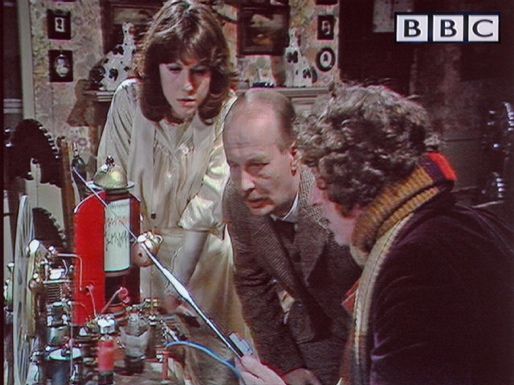
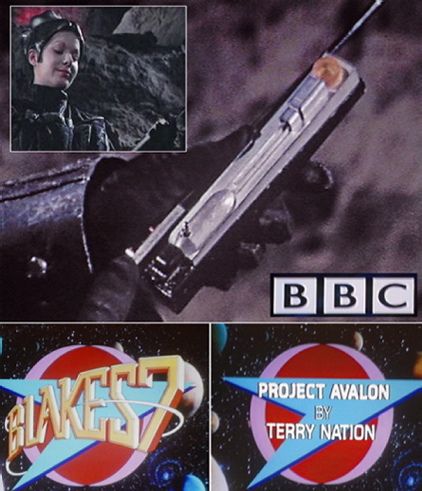
The original, screen-used prop from the 1975 classic. Tom Baker is seen producing the stellar receiver from his pocket, extending the side aerial, and tuning into the same signal being received by the Marconiscope made by Laurence Scarman. The message is Beware Sutekh! The unique prop, made by Ian Scoones was kept in the BBC effects store, and made a prominent appearance in an early Blakes 7 story Project Avalon.
 
Above, Tom Baker using the Stellar Receiver to verify the signal from Sutekh. Sarah Jane Smith looks on, with, centre, Laurence Scarman (played by famous Who character actor Michael Sheard). The prop has an extendable aerial, a rotating knob which moves a red marker up and down a numbered scale (still working perfectly), and a two-way metal switch (prominently used in Blakes 7). The original, orange lens is mounted on top at one end. There were never any electrics in this prop, made by Ian Scoones who was the visual effects designer on Pyramids of Mars. Ian gave it to renowned Who expert and author Richard Bignell, when Richard interviewed him in 1990, for the fanzine Proteus.
 
Here is the same prop, pictured in close-up use by Glynis Barber, signalling to the underground-living Mutoids to assemble....to be shot! Glynis uses the lower knob to adjust the numbered scale, and repeatedly flicks the metal switch to send out a signal. This was filmed, on location, using 16mm, three years after Pyramids of Mars. This Blakes 7 episode, Project Avalon, was written by Terry Nation.
The Arc Of Infinity. Omega effects head
This Omega Head was originally purchased by Chris White at the Doctor Who a Celebration at Longleat House in 1983. It can be seen in the story Arc of Infinity (January 1983)when the character of Omega is transforming into a solid form - that of the Doctor, Peter Davison. The head, which can screen-matched in several ways, consists of 3 parts. This full head was bought by Colin Young (Dont miss his collection pages!) in May 2006 from Chris White who was the only owner of the item from its original purchase, it was then sold in June 2008 to Chris Balcombe. Pictured is the entire head, complete (right) with the head globe. The Arc Of Infinity is now available on DVD, with lots of extras, and is a 2 Entertain/BBC production.
Omega effects head
There were (unless someone can update Chris!)four Omega heads featured in the episodes. A hero prop, worn by Omega for all the main scenes, then three rubber special effects heads, used for the transformation sequence in the final show. This one can be called head three, and is clearly seen as Omegas outer skin begins to break up, and get covered in glistening goo! Each head was hand-painted, and all differ slightly in apperance. This is how head 3 appeared on screen in the final cut.
Omega Head, continued
This is the first head appliance applied, and is a one-piece flexible rubber mask, which gives the fat cheeks and full chin-flaps of the final head. Thanks to Arc of Infinity being released on DVD by the BBC and 2Entertain, behind the scenes sequences have helped identify this particular head. The hand-painted stripes can be clearly matched to this prop. Also, inside this first mask, there are plastic tubes, which are thought to have been inserted either to inflate the cheeks to make them pulsate, or to insert slimy liquid to be pumped through during the deterioration recording. Screen grab on the left is copyright BBC and my thanks to 2Entertain for revealing it.
Yet more on the Omega head
Apologies for so many pictures, but its an interesting piece. Here again, we can see the initial head appliance being fitted, with our prop on the right.
Omega head close ups
You can start to match up the hand-painted details here, with the onscreen close-up on the right. Small black flowing stripes painted on, can be seen on the prop as it is today, left.
Close ups of the inner effects tubes
Inside the initial cheek and chin appliance these plastic pipe fittings are still in place, ready for piping to be attached to pump either air of slime into the head. The tube on the right is in the chin flap section, so would presumably been used for slime pumping. Chris would be delighted to hear from anyone who has more knowledge on this head and how it worked. He is also curious to know if the initial one-piece cheek and chin moulding is the same one used in the earlier effects head sequence, with a different top head applied. Incidentally, the final effect head used was a simplified, all-in-one head, used for when Omega is thrown from his chair, and also when the mask is ripped off to reveal Peter Davision.
Head of Omega, both parts ready for assembly
Here you can see how the upper section is lowered onto the all-round cheek mask.
The Tissue Compression Weapon used by The Master
Anthony Ainley used two versions of the TC gun. This intricately-made, heavy brass and copper device was the most often-seen, second version. Used by The Master in many episodes, but in particular close-up in Castrovalva (when The Master uses it to attempt to open the Doctors tardis casket, TimeFlight (after he reveals his true identity), Mark Of The Rani in 1985 (extreme close-up in action at the gates of the iron works), and Planet Of Fire in 1984, when first The Master fires it at two space suits to show Peri what it can do, then fires it at her as she flees into his Tardis, then Peter Davison uses it to destroy the android Kamelion - which had been under the mind control of The Master. In The Five Doctors, Ainley has this gun, or a simply-made stunt version of it, (if you know which, please let Chris know) knocked to the ground after the good old Brigadier punches him unconcious in the final episode. Today, the weapon is still fully functioning, with four leaves opening at the bulb end via a special mechanism. Wired up to a battery, the illuminated end lightbulb still shines brightly. The bulb was usually surrounded by cotton gauze shaped into a ball, to give it a more impressive look as it was fired. As one of the most famous hand-props of the series, it attracted fierce bidding, but was successfully purchased by Chris at the 2005 UK Bonhams Knightsbridge auction, where it was one of many pieces from John Nathan-Turners own collection. Below, the weapon as seen on screen in firstly The Mark Of The Rani, then in Planet Of Fire, with the final frame of the strip (with the Brigadier) from The Five Doctors.
 
Mark Of The Rani, featuring the weapon in close up. A visual effect glow was added once the gun-leaves open to fire.
 
Again we see the Masters weapon in action, this time being used by Peter Davison himself as The Doctor, to destroy the shape-changing robot known as Chameleon. The lower screen grab is from The Five Doctors and is thought to be this gun. But its quite possible another stunt gun was available, to be used when the weapon was thrown to the ground or used to hit someone....thus preserving our close-up gun in good condition for detail scenes where the front petals open up.
Original Five Doctors screen-used figures
The original figurines of all the classic series Doctors and companions who appeared in the anniversary Five Doctors episodes. The figures include Jon Pertwee, Patrick Troughton and Peter Davison, and the Brig. Poor old Tom never made it as a figurine... he got caught in a time vortex, perhaps the penalty for refusing to return for this anniversary show! The figures, sculpted in milliput, were purchased by Chris at the Bonhams auction in London, where much of the remaining collection of John Nathan-Turner and Gary Downie was sold.
 
The figures were modelled by artist Sue Moore, who had previously made numerous models for the fan market but was eventually commissioned to create these figures for The Five Doctors. With thanks to www.doctorwhoprops.com for the extra information
 
Seen above, the Five Doctors figures as they appeared on screen
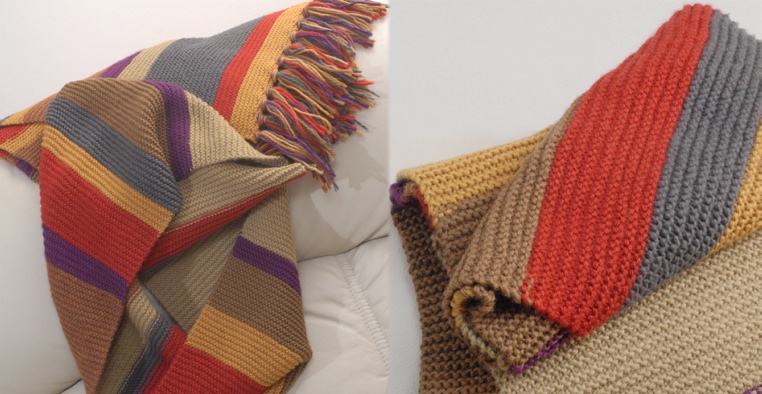
Chris Brimelow replica Season 12 Tom Baker Scarf
Chris Brimelow is fast becoming known as the very best maker of Tom Baker replica scarves. Having compared Toms original scarf (sold at Bonhams...CB was there...should have bought it!), Chris, from the USA, is now managing to exactly colour-match virtually ever colour and thickness of the original 1970s wool, and produced this beauty in perfect garter stitch with lovely width and length. If you put it round Toms neck you would say it was original (though in slightly better condition!)
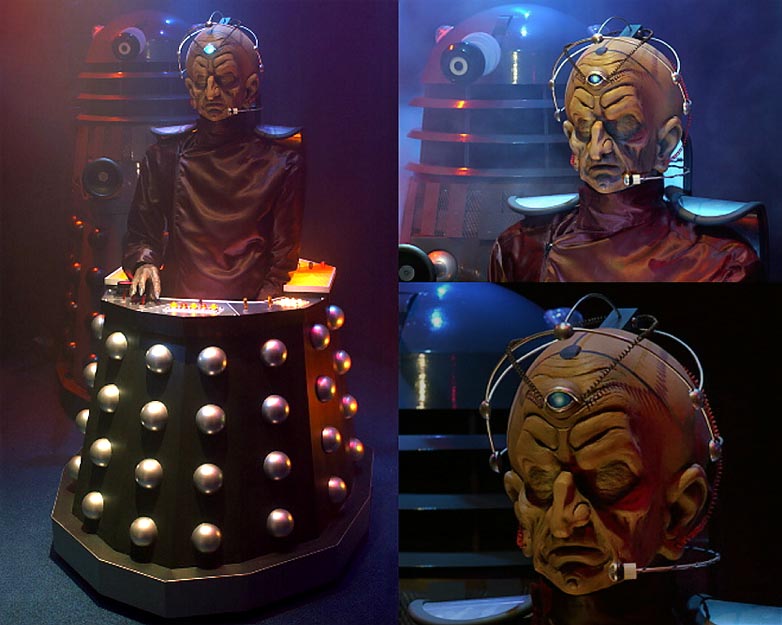
Exact replica of Michael Wishers Davros
If Chris cannot get the real prop, the next best thing is an exact replica, and they dont come more accurate than this. Measured from the original chair and back support, and constructed from the same materials as used in the original Genesis Of The Daleks Davros chair, right down to the patterned perspex and resin operating knobs on the console. Davros himself is wearing a black tunic taken from the original pattern and made from the same material. And as for the star himself. The head is a cast from an original head pulled from the John Friedlander moulds. You cant get any closer! And the best news, for Chris at least, is that he has at last tracked down the EXACT illuminating console switches as used by the BBC back in the seventies. These are awaiting fitting and new pictures will follow. It only took five years of searching!
Original Cybergun from Silver Nemesis
The only known original gun to survive after the recording of Sylvester McCoys SILVER NEMESIS, where he and Ace faced the gleaming, silver-plated cybermen. The helmets, chestplates and guns were all treated with a silver-plating process, then laquered to protect the high-gloss finish. But, upon expsoure to daylight, John Nathan-Turner realised that the laquer began to turn yellow...almost gold! Somewhat ironic, with gold being any cybermans poison. The remains of the silver plate, under its goldish laquer, is visible over much of this screen-used gun. Most of the Nemesis guns were dismantled and the same firing mechanisms used in the Happiness Patrol guns. Below, another view of the complete gun as it is today.
The only known remaining Silver Nemesis Cybergun
 
Special Effects model Dalek used in Revelation of The Daleks
For a sequence in the Colin Baker series REVELATION OF THE DALEKS (1985), a white dalek is seen firing at two intruders, but it then disintegrates. This effects shot was recorded separately from the live action studio, and used a model based on the Sevans dalek model kit, modified by Stuart Evans who had been commissioned by the BBC to alter it for this episode. An internal wire allowed the head dome to move from side to side, and the dome lights were given working light bulbs to flash in time with the dalek speech. A video pixelation effect was eventually used to destroy the dalek after it fired its blue beam, so the model, painted up in white and gold by the BBC, survived completely intact. It remains the only COMPLETE screen-used BBC dalek that Chris owns. Shame its only about a foot high! Below, the dalek in action on screen as it fires the exterminator gun
 
 
Original, screen-used Dalek Trooper Helmet presented by BBC
This Helmet was made for the 1984 story Resurrection of the Daleks and is made from fibreglass and constructed in three parts. The small plastic domes are stock items from an EMA model parts catalogue painted in brush-on grey Hammerite which is also applied to the corrugated area of the eye stalk. Inside the helmet there is the interior head band from a work-mans hard hat and an elasticated black chin strap. The helmet is painted in high gloss black, and there are also the small remains of the clear perspex visor on the left hand side.
 
Only a small number of these Helmets were made for the story, a few of which were sold at the Bonham’s Doctor who auction in 1991. A huge problem with these Helmets is the number of rather heavyweight, incorrectly-moulded fakes that have been made over the years. Some have even been sold with PHOTOCOPIED Bonham’s receipts making authenticating them almost impossible. What makes this one unique is its 100% authenticity. Read on!
 
This particular helmet was won as part of the 1984 BBC design a monster competition and comes direct from the original competition winner along with three letters from the BBC, one of which confirms that the helmet was screen-used, and newspaper articles from the time showing him wearing the helmet and using a prop gun (part of his prize....see my Vengeance On Varos gun). History like this is invaluable and anyone who is offered a Dalek Trooper helmet should demand a VERY detailed cast-iron history. I am very grateful to www.drwhoprops.com for his help with this description.
 
 
Vengeance On Varos Guards Gun
This was included with the Dalek Trooper Helmet (seen above) as one of the BBC prizes given to the young winner. At the time, the BBC mistakenly called it a cyberman gun, but it was only used in Varos. This is an original, screen-used gun, made by (and confirmed by) Martin Bowers, from resin, plastic and machined aluminium, with a working, pull-back trigger. Martin made at least two different designs for the Varos guns, and this one features in several scenes.
 
The gun in use on screen, in Vengeance On Varos
Warriors Of The Deep original mask
One of the three original masks worn on screen in the Peter Davison series WARRIORS OF THE DEEP (1984). The latex rubber remains in remarkably good condition for its age. Chris keeps the mask in a light-tight, glass-covered case to best preserve it. This was the mask used to take a mould from, to produce a rubber toy mask in the eighties, licenced by the BBC and made by Imagineering.
Silurian Wrist Communicator, Warriors of The Deep
One of the three existing original wrist communicators worn by the Silurians in the Peter Davison episodes WARRIORS OF THE DEEP (broadcast January 1984). This one has been screen-matched and appears in semi-close-up in scenes on the bridge of the nuclear base. Originally bought at the UK Bonhams auction in 1993, lot number 469a. Only three silurian costumes were made for the series.
 
The wrist communicator, otherwise referred to as communicator bracelet, in close-up
 
The very same wrist communicator as seen in the show
Screen-used Silurian shell from Warriors of the Deep
Above, a screen-used Silurian Torso, used in the Peter Davison episodes Warriors of The Deep. This particular fibre-glass, front and back body armour, worn by the reptilian Silurians, was specially rigged with a small explosive charge in the chest, which ignited during the final scenes, when the Doctors companion Turlough shoots a silurian on the bridge of the nuclear base. The original wiring for the charge is still in place. This goes well with the original Silurian head in Chris collection
The giant Fly from The Green Death
The close-up giant fly built for The Green Death (1973) and used in several scenes as the series reached its climax and Jon Pertwee realises that one of the larva has pupated into a large killer fly, able to squirt deadly green liquid at enemies. Built by Colin Mapson under the direction of designer Ron Oates, the fly prop is made from wood, furniture foam, latex and plastic, with wire-framed wings (only one of which survives and has been restored). Below, this prop can be seen in action, eventually being downed by Jon Perwtee, who hurls his cloak into the air to trap it.
 
The close-up giant Fly prop, as seen on screen in The Green Death
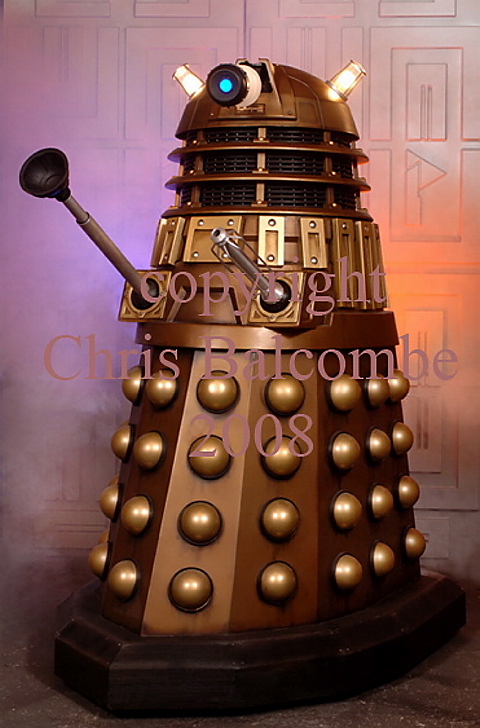
Gold Dalek
Identical in materials and paint colour, and from the same moulds as the original Dalek featured in Chris Ecclestons debut series. Constructed from fibreglass, wood, aluminium and rubber. Far heavier than the Genesis dalek owned by Chris, the new series daleks were initially constructed by Mike Tuckers team. It was hoped the same team would continue to build the props for the rest of the series, but the contract was awarded to a company in Wales, where the production process was simplified and different materials used. This dalek has been fitted with a voice box and is fully functional, only lacking the remote-controlled dome, as it didnt eventually appear on screen. The original rubber daf oil seals surround each hemisphere, and the eye ball is the original design, which features an extra border ring around the blue eye, making it smaller in circumference than later daleks. This was a very kind gift to Chris, and naturally has a commanding position within his collection. Photographs of this dalek have appeared in TVTimes, various other TV listing magazines, as well as publications across the globe.
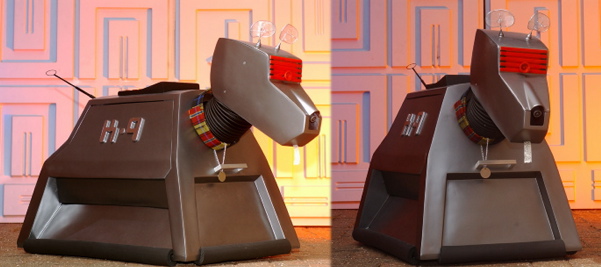
K9, the Doctors faithful metal friend
Cast from a mould taken from the original K9 who accompanied Tom Baker, but without the extra head shape changes made to the main screen-used prop, this replica matches the stunt K9 seen in episodes where the poor old metal dog is upside down having a wiring change, or is being lifted up (the second version lacking any internal motors so easily liftable). This K9 has been fitted with remote-control, enabling it to travel, the head antenna to extend, tail wag and ears wiggle. The lights on the top control panel in the same pattern as the original hero prop.
Studio Plans for Remembrance Of the Daleks
Original BBCtv studio plans for Remembrance of the Daleks. Three sheets, detailing the cafe, two space ship interiors, school, cellar, and Army HQ used in TC8 at Television Centre, London, in late April 1988.
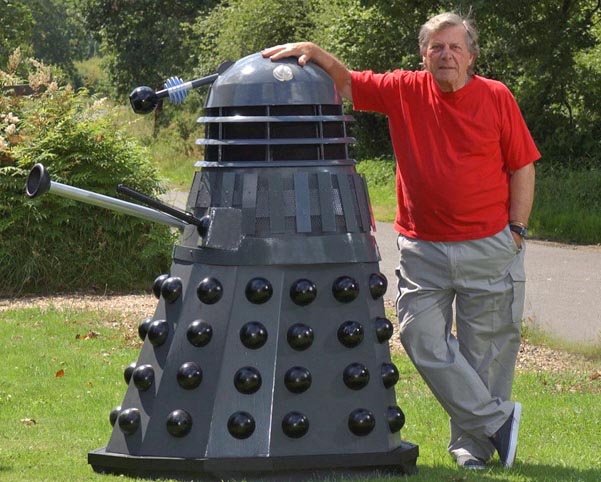
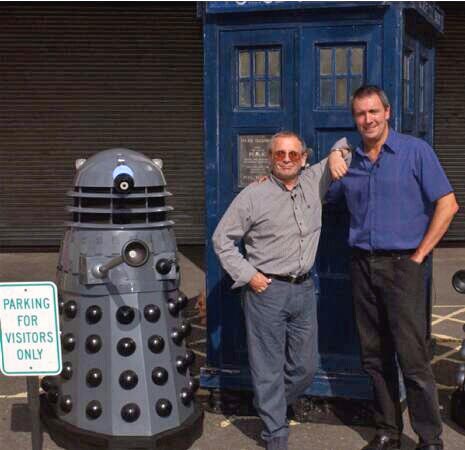
Replica Genesis Dalek with Raymond P Cusick
It was a real pleasure for Chris when he was assigned to complete a photo shoot with ex-BBC designer Mr Raymond P Cusick, at his home in Southern England. Chris took along his replica Genesis-style dalek, which has, over the years, appeared in action on TV and at the movies advertising Kitkat chocolate bars. It also came up against Sylvester McCoy, see below, when Chris had to argue the case for the return of the daleks, when their future was in doubt, as recording of the new series with Chris Eccleston was in the planning stages.
 
The Genesis dalek at BBCtv South, with Sylv
 
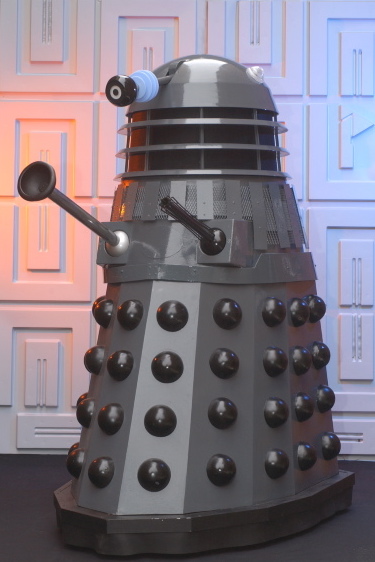
Here it is again, with a neat backdrop from the new series!
 
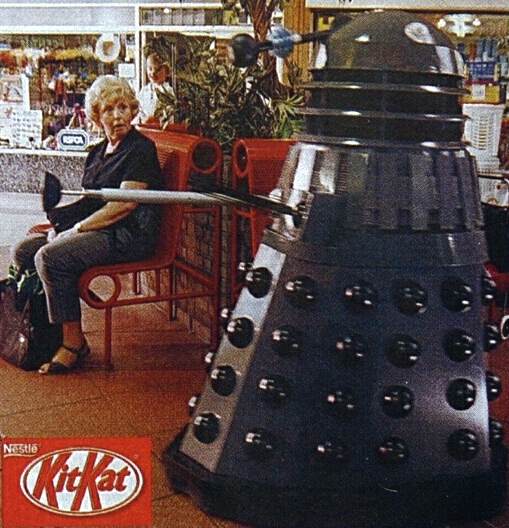
The same dalek making its starring appearance in the TV and Cinema Kitkat advert, filmed inside a very warm South London shopping arcade. You can watch the advert on Youtube, where someone has placed it. No copyright infringement is intended by copying out this link (sorry - you cannot do a click-to-page link on this page): http://www.youtube.com/watch?v=XznuoDdv-IM. Or go to YouTube and search the words dalek kitkat. Nice to prove that not just short people can operate daleks. At six foot three inches, the dalek fits him like a glove (and has the same effect as sitting in a sauna for an hour)
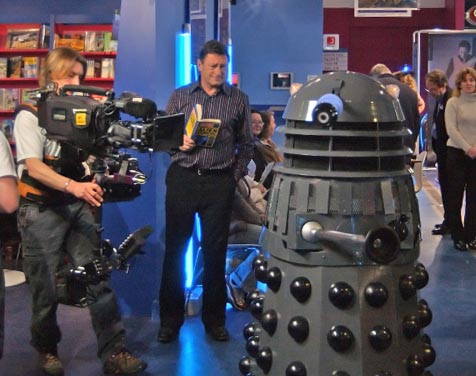
The Genesis dalek in action, on 20th Century Roadshow
As host Alan Titchmarsh, centre, reads a guide to Aliens, BBC steadicam operator Nathan Ridler (left) records Chris in his dalek gliding by (and shouting Exterminate), during the making of the Twentieth Century Roadshow programme.
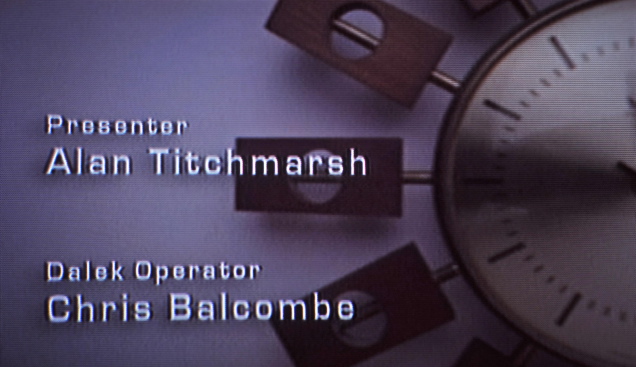
End credits
End credits of the BBC programme Twentieth Century Roadshow. Now if only Nick Briggs and Barnaby Edwards hadnt been around for the new series.....
Planet Of The Daleks original camera script
Original camera script for the epic Jon Pertwee story Planet Of The Daleks, episode six.
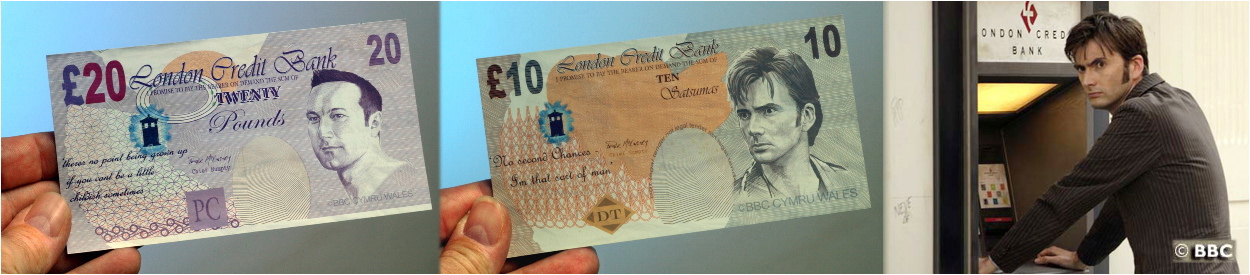
Original stunt banknotes from David Tennants The Runaway Bride
From David Tennants episode The Runaway Bride, broadcast at Christmas 2006, come these two prop banknotes, made for the BBC to use in the scene where the good Doctor goes to a hole in the wall ATM and, using his multi-skilled sonic screwdriver, causes the machine to send dozens of bank notes flying out into the air, causing a diversion while he and Rose escape. The notes were never seen in close-up, but BBC Wales thought it would be amusing to have the faces of David Tennant on one, with the words Ten Satsumas, and series producer Phil Collinson on the £20 version. Each note is double-side printed in very fine detail. Beware clever forgeries! Copyright BBC Wales
Original Cyberman suit from Earthshock
A complete cyber suit from Earthshock. The latex has now hardened, leaving the suit almost impossible to wear. The suit was worn by actor Steve Ismay in the Season 19 Peter Davison story Earthshock. Steves name is written on the neck label. Chris has lost the original details from the person he bought this suit from, and would be very grateful if they could get in touch again. Suffice to say it is 100% genuine. These costumes were constructed from pilot flight suits sewn onto boiler suits to fit the actors. Simple, cut-up sections from string vests were used as extra patterning on the arms, legs and body, then given a light covering of latex before silver paint was applied. Chris also owns one of the original RAF flight suits in mint condition. These semi-transparent outfits were used, unmodified, as costumes in other BBC sci-fi series. The intricate tubing lent itself perfectly to a futuristic feel.
Original Stunt Cyber Chest Unit
Converted from a standard Earthshock Cyberman chest unit, this was split at the tube section, and the rigid moulded tubes replaced by three bending plastic flex tubes, to allow stunt cybermen to fall over and roll wiothout causing damage to themselves or the costume piece. The unit was used extensively in cyber death scenes in the Five Doctors and in Attack of the Cybermen. It then remained with the BBC and was converted, with a new chest design applied with flashing light, and the rest of the unit painted black. It featured in a short-lived comedy show. Chris has removed (but kept) the modified chest plate and resprayed the whole unit to bring it back to its former days of glory.
 
This is how the cyberman chest unit arrived. Still in its repainted BBC colours. It featured a side switch to illuminate lights under the central triangle. A very helpful forum member, or visitor, helped out Chris identifying which BBC comedy show this was used in. Chris has now lost those details, and would be VERY gateful if that person could get in touch again!
Original Davros Head made by Stan Mitchell
This is the back-up Davros head moulded by tv effects man Stan Mitchell, for the scene in Revelation of The Daleks, when the head of Davros is shot at and deflates after spinning around. The first take was successful, so this latex head wasnt required and remained unpainted. It was kept by Stan until visited by Dr Who models entrepreneur Stuart Evans, of Sevans Models. Stuart was given the head, filled with foam to hold its shape, as a gift. Chris keeps it in a blacked out box in a glass case, to prevent light deteriorating the latex rubber. Pictured right is Stan trimming the cast head.
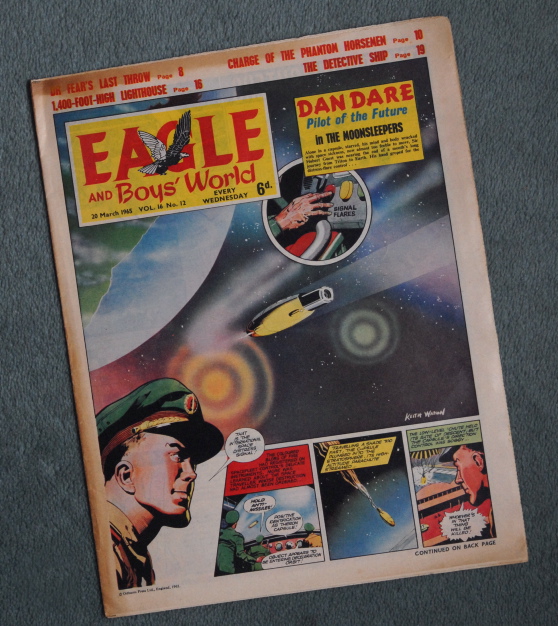
Original Eagle Comic. The same issue read by Peter Cushing
Dated 20th March 1965, it was this issue of The EAGLE comic that actor Peter Cushing was filmed reading during the opening front-room sequence in the first dalek big screen adventure DOCTOR WHO AND THE DALEKS. A Dan Dare story features prominently on the cover. The cinema film, which showed the audience the daleks in colour for the very first time, was a box office hit. Chris wishes this was THE actual copy featured, but it is the nearest you can get. In near-mint condition with slight browning to the top of some pages.
Original Mike Kelt Tardis Console Plans
Above and in the two shots below, a very rare original set of plans for the Classic Tardis console. These are the plans for the console used from the Five Doctors onwards, designed by Mike Kelt, and come in eight sheets, detailing all measurements. Showing signs of fading, these sheets are now packed away in storage, so please no requests for photocopies.


Original Cyberman Gun from Attack of the Cybermen
One of the most copied Dr Who props around, so buyer beware if you are ever offered a cybergun claiming to be from Earthshock, The Five Doctors or Attack. This screen-used example, originally built for Earthshock by Martin Bowers, went through the wars in both Earthshock and Attack, with its front perspex tube section smashed at least once, and the front section (made from a 1980s Ventaire Car Air Freshener) broken off. It was rescued by a well-known props man working on the series, who is still heavily involved with the BBCWales effects, and ended up being almost completely refurbished by an ex-BBC Dr Who visual effects man. It still retains a crack running through a portion of the main body, but this has been left as found. The front filter section is made using exactly the same type of Ventaire freshener as Martin used. Chris, ever suspicious of these weapons, got Martin Bowers to give this gun the once over, and Martin kindly confirmed it to be, in his own words, a refurbished original gun. It also starred in the BBC 20th Century Roadshow (see clip at top of page). There are VERY few originals in existence. But there are probably between at least 80 to a 150 replicas in circulation, so beware! Martin actually holds copyright on these guns, and was none too happy that the BBC granted a licence to another modelmaker to produce reproductions of his Earthshock guns.
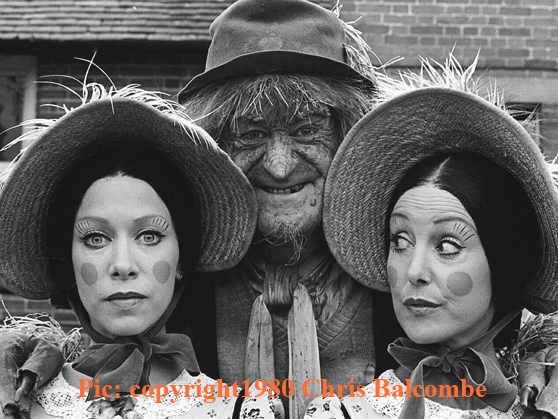
Jon Pertwee as Worzel Gummidge
Jon Pertwee left TV sci-fi after Doctor Who, and was to become another famous UK televison character, a daft scarecrow which came to life called Worzel Gummidge. Made by Southampton-based Southern TV for the main ITV network, and broadcast from 25/2/1979 to 12/12/1981, with thirty one, 30 minute episodes over 4 seasons, plus a Christmas Special. Filmed in the countryside of Hampshire, and mainly in the village of Braishfield, (ie: not far from Chris), there were several media press calls to get the series publicised in the national press. Chris had the chance to photograph Jon as Worzel twice, and this was shot on location, with Jons co-star Una Stubbs, as Aunt Sally, right. On the left, for that particular episode, Una had a rival Aunt Sally, played by Connie Booth, co-writer and co-star of the John Cleese hit Fawlty Towers. As always, Jon was a gentleman at the photo session and did anything required.
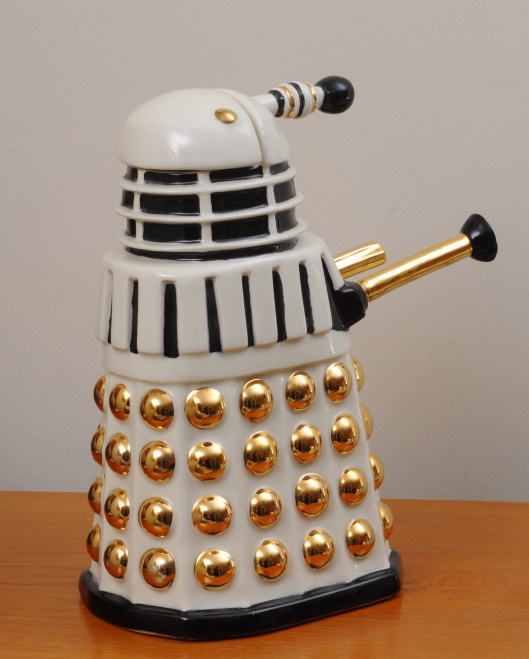
Prototype Dalek EXTEAMINATE Teapots made for BBC
A UK novelty teapot company, Gary Seymour Teapots, wanted to produce a set of limited edition Dalek teapots about eight years ago. Following BBC licencing guidelines, a small number of example teapots were cast, glazed and painted in the different colours that were proposed to be offered. But, sadly, despite the high quality of the products, the licence was refused. This may have been because the BBC were looking for more mass-produced items, rather than small number production runs. The makers couldnt sell the pots, since they remained unlicenced, so they were given away to loyal Seymour pot customers and one to a teapot museum. Chris now has an example of each colour test. The rarest is the black and gold version, of which only two were made. One is in a museum, in the UK, Chris has the other. The moulds were destroyed and the company moved on to other designs.
Another colour test, and even the very first ceramic biscuit jar!
Gary Seymour tried this colour scheme too, some having both the gun and plunger arm as pouring spouts, some with one sealed, to make serving easier! He also, seen in the picture below, with just two castings, had a go at a handle-less biscuit container.....years before the large official dalek biscuit barrels hit the market.
The experimental biscuit container. No handle, and a little tricky getting your cookies out!
 
Replica Earthshock Cyberman
This suit made, as the originals were, from an old UK Royal Air Force flight suit which kept the pilot coled by circulating water around his body via tubes in the suit. The RAF suits were stuck onto standard 1980s light boiler suit overalls, to give them more size, then given a layer of rubber latex, which was then spray and brush-painted with silver paint. The helmet and chestplate are both moulded from pieces from the original Earthshock Imagineering parts. The boots are the only non-Earshock copies. They used awful Moonboots in the series, which are next to impossible to find now. But for The Five Doctors, and Attack of the Cybermen, they used 1980s lace-up boots, which this copy wears. An exact working replica of an Earthshock gun, made by the same visual effects man who made them for the 30 Years In The Tardis documentary. The guns contained camera flashguns, triggered by a switch under the centre of the gun. Fully wearable, the suit featured in the BBCtv Twentieth Century Roadshow programme, and can be seen in the clip at the top of this page.
Floorplan model set design for Remembrance of The Daleks
The original floorplan layout, including card models for every set to be used in the studio on the shooting days at TV Centre in London. Intricately-detailed, it includes the cafe, school, cellar and dalek Mothership bridge....which even includes a tiny card dalek! Rescued from the rubbish skip by one of the shows production workers, and kept by his son ever since, until Chris got his hands on it!
Vengeance On Varos Governors Costume
The original costume worn by actor Martin Jarvis, in his role as the Governor on the planet Varos, in the Colin Baker series VENGEANCE ON VAROS. Includes the neck decoration, sash, belt and even socks that Jarvis wore in what was, at the time, dubbed as one of the most violent Dr Who stories ever. Purchased from Mark Short, who bought it at the original Bonhams Dr Who auction.
Prototype Model dalek by SEVANS
Before model-producer Stuart Evans gained the licence to produce his excellent range of model daleks, he to take a prototype along to the BBC to show them exactly what he could do. This is that very prototype, heavy and built from wood. plastic and metal, it includes flashing dome lights. It impressed the licencing team at the BBC, and Stuarts vast range of SEVANS models soon hit the market.


If you have any original, screen-used Doctor Who props from the current or original series, and are interested in selling, please feel free to drop Chris an email.


All photographs on this website are the copyright of either the BBC, where credited, or Chris Balcombe, They cannot be used or reproduced without explicit written permission. The daleks are copyright BBC and Terry Nation's Estate. Full size daleks of every type are available to buy from This Planet Earth, at www.thisplanetearth.co.uk/

Chris can be contacted by Email Chris


Have a Collecting question then try the
Message Board

If you collect Doctor Who costumes, props, scripts, Artwork, set designs, or commercial items we would love to add your collection to the list. (click) For more information...

Return to the Collector listing Page

Return to home page

85596